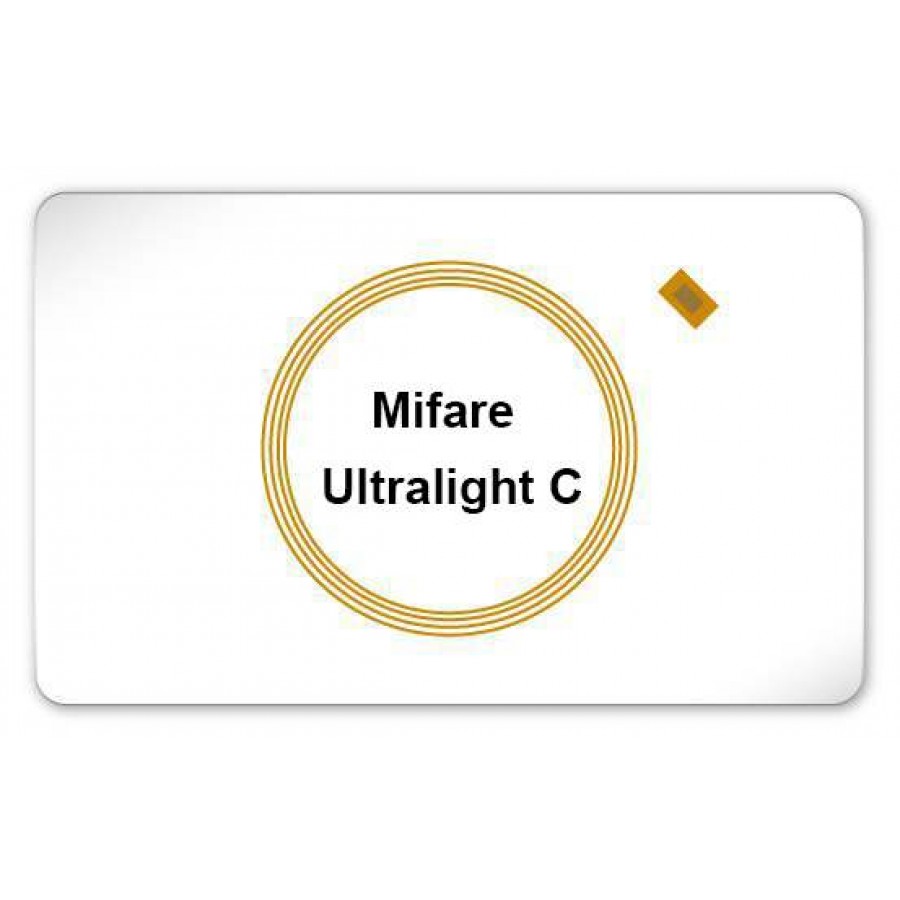
13.56MHz NXP Mifare Ultralight C RFID Blank Cards Pack of 100
- Product Code: RCC11
- Availability: In Stock
-
$35.00
- 5 or more $22.03
- 10 or more $18.41
- 50 or more $17.69
- 100 or more $17.11
The MIFARE Ultralight C is a low-cost, high-frequency (HF) contactless smart card IC developed by NXP Semiconductors. Designed for single-use or limited-use applications, it provides a cost-effective, NFC-compatible solution with basic security features, making it ideal for disposable tickets, event access, and low-value micropayment.
1. Core Definition
MIFARE Ultralight C is a passive, 13.56 MHz RFID chipcompliant with the ISO/IEC 14443-3 Type A standard. It is the secure successor to the MIFARE Ultralight EV1, featuring triple DES (3DES) authentication for improved security while maintaining the same memory capacity (192 bytes) and cost profile. It is commonly used in paper tickets, smart stickers, and NFC tags.
2. Key Technical Specifications
Parameter | Specification |
Chip Model | NXP MIFARE Ultralight C (e.g., MF0ICU2) |
RF Standard | ISO/IEC 14443‑3 Type A (NFC Forum Tag Type 2) |
Frequency | 13.56 MHz (HF) |
Memory Size | 192 bytes EEPROM (48 pages × 4 bytes) |
User Memory | 144 bytes (page 4–39) |
Security | Triple DES (3DES) authentication; 7-byte UID, 16-bit write lock protection |
Data Rate | 106 kbit/s |
Read Distance | Typically 2–5 cm (paper ticket form factor) |
Write Distance | Typically 1–3 cm |
Write Endurance | 100,000 cycles |
Data Retention | 10 years |
Operating Temperature | -25 °C to +70 °C |
3. Memory Structure
The memory is organized into 48 pages of 4 bytes each:
- Page 0–1: Serial Number / UID (7 bytes) and manufacturer data (read-only).
- Page 2: Lock bytes for write protection of pages 0–15.
- Page 3: OTP (One-Time Programmable) bytes (e.g., for ticket validation marking).
- Page 4–39: User memory (144 bytes).
- Page 40–47: Configuration, authentication, and counter pages (including 3DES keys, authentication configuration, and 24-bit one-way counter).
4. Security Features
- Triple DES Authentication: A mutual 3DES challenge-response protocol (two 56-bit keys) protects read/write access to the memory. Without authentication, the chip behaves like a standard MIFARE Ultralight (read-only).
- Lock Bits: Each page can be permanently write-locked via lock bytes.
- OTP Bytes: 4 bytes of One-Time Programmable memory (page 3) for marking tickets as "used."
- One‑Way Counter: A 24-bit decrement-only counter (e.g., for ride-counting applications).
5. Common Applications
- Disposable Transit Tickets: Single-use or limited-use paper tickets for buses, metros, and trains.
- Event & Festival Access: Wristbands or paper tickets with authentication to prevent cloning.
- Low-Value Micropayment: Loyalty points, vending machine credits, or canteen tickets.
- NFC Tags: Smart posters, product authentication, and simple interactive tags.
6. Comparison with Other MIFARE Ultralight ICs
Feature | MIFARE Ultralight (Original) | MIFARE Ultralight EV1 | MIFARE Ultralight C |
Memory | 64 bytes | 192 bytes | 192 bytes |
Security | None (read/write open) | Password protection (16-bit) | 3DES authentication |
Counter | None | 24-bit one-way counter | 24-bit one-way counter |
Primary Use | NFC tags, read-only | Limited-use tickets | Secure disposable tickets |
7. Advantages
- Low Cost: Optimized for high-volume, disposable applications.
- Enhanced Security: 3DES authentication provides a higher security level than password-only protection (EV1) while remaining cost-effective.
- NFC Compatible: Fully compliant with NFC Forum Type 2 Tag specification, enabling smartphone interaction.
- Ease of Use: Simple memory layout and standard 144-byte user area.
Summary
The MIFARE Ultralight C is a secure, low-costcontactless IC tailored for single-use or limited-use ticket applicationsrequiring basic cryptography. Its 3DES authentication provides a significant security upgrade over earlier Ultralight versions, making it suitable for transit operators and event organizers needing to prevent casual cloning while keeping per-unit costs minimal. For higher-security or reusable applications, NXP recommends moving to MIFARE DESFire or MIFARE Plus.